End of life
Signs that death is near What to expect in the final days
Updated September 2026
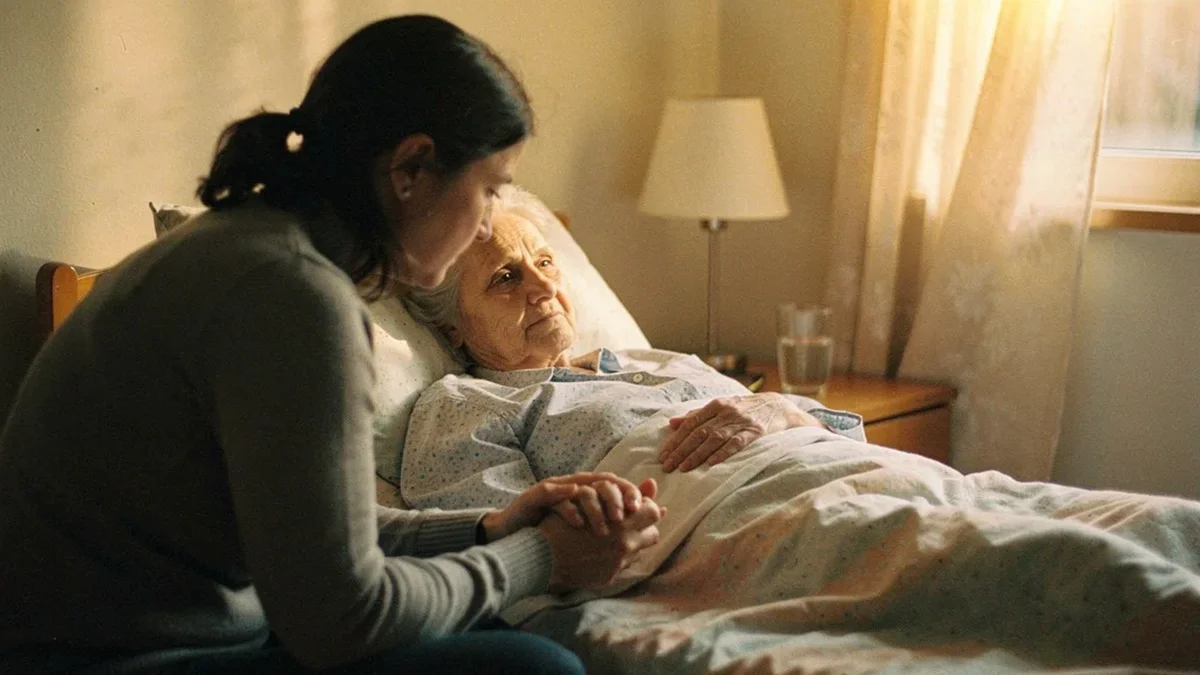
Article images are AI-generated illustrations. Some may include AI-generated people; they are illustrative and do not depict real caregivers, patients, experts, or FamilyCareWise contributors.
TL;DR: Dying usually moves in stages: fatigue and pulling inward in the final weeks, then breathing and skin changes in the final days, then a last stretch of stillness clinicians call actively dying. Most of what families see, including the death rattle, is not painful for the person. Presence matters most.
In the final weeks, a dying person typically sleeps more and eats less. In the final days, breathing changes, skin cools, and consciousness fades. Clinicians call the signs closest to death actively dying.
Watching a parent move through this is hard. Some physical changes are expected near death, but a new sign can still mean discomfort that the care team can ease. The signs differ across three stages: the final weeks, the final days, and the final hours. Each stage calls for its own response.
Signs that death may be weeks away
In the weeks before death, the body gradually shifts its energy away from everyday functions. The National Institute on Aging (NIA), part of the NIH, describes fatigue and low energy as common as people near the end of life, along with fears about the unknown or about being alone that a person may not say out loud.
Feeling tired most of the day is common as death approaches: NIA notes that people nearing the end of life often have little or no energy. Simplifying daily tasks, such as using a bedside commode instead of walking to the bathroom, can help.
Focusing inward. According to the National Cancer Institute (NCI), people often turn their attention inward during the last weeks of life. This does not necessarily mean a person is angry or depressed; NCI attributes it to decreased oxygen to the brain, decreased blood flow, or mental preparation for dying.
Eating and drinking less is common too, and NIA's guidance is direct: don't force a dying person to eat. Losing one's appetite is a normal part of dying. Going without food or water is generally not painful, and eating or drinking can add to a dying person's discomfort.
Speaking to people who are not there. NIA describes dreams of meeting deceased relatives, friends, or religious figures that can comfort a dying person. Confusion or delirium can also cause visions, sometimes frightening ones. Listen without arguing, and tell the care team if your parent seems distressed or suddenly more confused.
Signs that death may be days away
In the final days, the body's systems slow more noticeably. NCI describes sleep increasing further, along with episodes of confusion or waking dreams: a person may lose track of time, place, or who is in the room. If agitation appears, NCI's guidance is not to restrain the person and to tell the care team, since treatments are available to help.
Loss of bladder or bowel control, and less urine, follow from the pelvic muscles relaxing, plus a slowing of kidney function or lower fluid intake, according to NCI. With less food and fluid, bowel movements may become less frequent too. The urine that is produced may be dark and smell strong.
Breathing that speeds up, slows down, or rattles. Breathing patterns may cycle between faster and slower, and rattling or gurgling sounds can appear from saliva and fluid pooling in the throat and upper airway. NCI is specific that this is usually not distressing for the patient, even though it is upsetting for families to hear.
Cooling, color change, and dryness appear too. NIA describes hands, arms, feet, and legs becoming cool as circulation slows, with some areas turning darker or bluish. Skin may also look blotchy or marbled, a change called mottling. NCI says the color change itself is not painful. Mottling alone cannot tell you how many hours remain. NIA separately notes dryness of the lips and eyes as a source of discomfort, eased with a damp cloth, ice chips, or a moistened swab.
Small jerks or twitches can occur near the end of life, according to NCI's last-days guidance. Tell the hospice nurse about a new movement, especially if it comes with distress; the team can check for a cause and help keep your parent comfortable.
What clinicians call "actively dying"
Researchers use the phrase actively dying for the cluster of physical signs closest to death. A study cited in the NCI's clinical summary on the last days of life tracked 357 cancer patients. Most of the following late signs appeared in the final three days:
- Pulselessness felt at the wrist
- Breathing paired with jaw movement
- A drop in urine output
- Irregular Cheyne-Stokes breathing
- The death rattle
- Pauses in breathing
- A bluish tinge to the skin, especially the hands and feet
Earlier signs, appearing more than a week out, included a drop in alertness, declining ability to perform daily tasks, and trouble swallowing liquids.
A second study in the same summary timed how long each sign lasted before death. The median ran 23 hours from the first death rattle, 2.5 hours from breathing paired with jaw movement, 2.6 hours from the loss of a pulse at the wrist, and just 1 hour from a bluish tinge in the extremities. Those are medians, not guarantees. The same summary adds that no single sign, or its absence, rules impending death in or out with certainty, and that predicting the exact time of death stays difficult even with careful, repeated observation. Families reading this as a checklist should hold it loosely.
Hearing is treated differently in this research than the other senses. NCI notes that even patients with very limited ability to interact may still be aware of who is in the room, and it encourages caregivers to keep speaking to a dying person as though they can hear, because they may.
When to call your hospice nurse
Call the hospice nurse for any change that concerns you, especially moaning, agitation, new breathing sounds, or signs of discomfort. The team can assess the change, visit, and adjust care for comfort. Calling does not mean death is about to happen right away.
What these signs are not
Two of the signs families find most alarming are worth a closer look, because the cited research describes them differently than they sound in the moment.
The death rattle is not choking: it comes from fluid pooling in the throat, not from struggling to breathe, and NIA and NCI both describe it as generally not distressing to the person experiencing it.
Unresponsiveness does not tell you what a person can hear. NCI encourages families to keep speaking to a dying person because some awareness may remain. Reduced appetite is common near death. Visions and changes in breathing deserve a call to the hospice team when they frighten your parent or raise concern.
How to be present during this time
The hour-by-hour medians described above are useful for orienting expectations, not for timing a vigil around: predicting the exact moment stays difficult even with careful observation, so it helps to treat presence as an open-ended commitment rather than a countdown. Families sometimes freeze during this stretch of time because they are not sure what helps. Presence is most of it. Sitting near your parent, holding their hand if they seem comfortable with touch, playing music they loved, and speaking in a calm, normal voice all count. Nothing profound has to be said. "I'm right here" is enough, and it matches what NCI's guidance encourages: talk to the person, not about them, since they may still hear you.
A bedside vigil every hour is not required. Stepping away to eat, sleep, or take a short walk is not abandonment. Some hospice staff and grief counselors have observed that a person appears to die in the brief window when the room empties, and families who experience this are not at fault for it.
If siblings or other relatives want to be present at the time of death, coordinate the timing with the hospice team so people have a chance to gather.
What comes after is its own subject. Our guide to grief after caregiving covers what many families experience in the weeks and months that follow.
Frequently Asked Questions
How do clinicians know when a person is actively dying?
Researchers who study dying cancer patients describe a cluster of late signs, according to the National Cancer Institute. Most appear in the final three days of life: pulselessness in the wrist, breathing paired with jaw movement, a drop in urine output, irregular Cheyne-Stokes breathing, the death rattle, pauses in breathing, and a bluish color in the hands and feet. In one study, the median time from the first death rattle to death was 23 hours. No single sign is certain on its own, and the same research notes that predicting the exact time of death stays difficult even with careful observation.
Is the death rattle painful for the dying person?
The death rattle is a gurgling or rattling sound caused by saliva and fluid collecting in the throat once a person can no longer swallow or cough it away, not a sign of choking. NIA and NCI both describe it as usually not distressing to the dying person, even though it is hard for family members to hear. Turning the person gently onto their side can reduce the sound.
What does it mean when a dying parent talks about seeing people who have died?
Some dying people speak about deceased relatives or friends, and the experience may comfort them. But confusion, medication effects, or delirium can also cause visions or frightening experiences near the end of life. Listen without arguing, and tell the hospice nurse if your parent seems distressed or suddenly more confused.
How long can someone stay on hospice care?
Medicare requires a hospice doctor and the person's regular doctor, if they have one, to certify a life expectancy of six months or less for hospice eligibility. Someone who lives longer is not discharged: the hospice medical director or hospice doctor can recertify continued eligibility after a face-to-face visit, and this can repeat for as long as the person remains terminally ill, according to Medicare.gov.
Should families try to get a dying parent to eat or drink?
Trying to get a dying parent to eat or drink is not the goal in the final days. Losing interest in food and water is a normal, expected part of dying, not something that causes death or speeds it up, according to the National Institute on Aging. The National Cancer Institute notes that forcing food or fluids in the final days can lead to discomfort or aspiration. Small sips, ice chips, or a moistened swab can still ease dryness without pressuring the person to eat.
The information on this page is for educational purposes only and does not constitute medical, legal, or financial advice. Every family's situation is different. Please consult a qualified healthcare provider, licensed attorney, or certified financial planner for guidance specific to your circumstances.